Weeknotes: 24th August 2026
Last week
Tessera group meeting
On Monday there was a small Tessera group show-and-tell in the lab for one of the funders, where I presented some of the habitat map work I've been doing with Tessera. The collective set of talks and demos spanned from how the Tessera sausage is made through to more higher level application of the model from people like myself and the ecologists. It's interesting to me that I was sitting on the ecology side of the fence for this one. In my career, whilst I feel I've shown I can do deep down and nerdy when required, I've always been more driven by the application of technology to have some impact rather than technology for its own sake, and that was very evident in where I sided in the in this show and tell. Not that I was the only CS person straddling that line, but I think it's good to know where one sits, particularly as this probably marks me as not a particularly good academic, at least within my nominal domain that I hold a degree and the one that pays my salary.
Indeed, this is what caused me to leave first academia and then commercial research a couple of decades ago, as it felt a bit disconnected from immediate impact. Not that I don't think research is important, far from it, but I personally get more joy and motivation from knowing that the work I do will enable others in some more obvious (to me) way. But that's why I've enjoyed being in academia so much this time around, sitting as I do between disciplines: I get to enable longer term research with that immediate feedback of enabling the ecologists I work with.
Many, many years ago I was part of the NESTA Crucible program, which took 30 early career researchers and aimed to try forester interdisciplinary collaboration. Whilst it was a lot of fun mixing with others from a wide range of disciplines, we all agreed at the time it was going to be a very hard program for them to assess impact wise. Here I am these days living the Crucible dream when that program is long since shuttered and I suspect anyone interested in it has moved on. But if anyone from those days does stumble over this, know that it was much appreciated :)
FOSS4G UK talk accepted
I submitted a talk on Yirgacheffe to FOSS4G:UK 2026 - Free and Open Source Software for Geospatial, UK for those wondering - which has been accepted. It's in Leeds in October, so I look forward to heading over for that and meeting up with the community there.
Data mapping
Last week I alluded to the challenges of limited data as I moved the focus of the habitat map generation from the UK to more biodivesity-wise interesting regions like Madagascar and Brazil. I've been forced to consider this a bit more as just pointing my pipeline as it was at the Brazilian state of Minas Gerais generated a fairly garbage map.
As mentioned last week, I'm dealing with limited data on two fronts: firstly from GBIF where I get species occurrence records, and secondly from OpenStreeMap data where I extract information about natural records and land usage. I showed a heat map last week of how biased GBIF clearly is to the places like Europe, North America, Japan, and Australia, but since I found a nice summary from 2021 of the biased distribution of GBIF records in Sampling Biases Shape Our View of the Natural World by Hughes et al. Although the paper is now five years old, the heat maps from GBIF today still closely match the diagrams and issues in the paper, so I feel it's still quite a relevant read. For my current particular line of investigation I found two particularly interesting observations:
- The sampling is biased by elevation: with both mountains and marine trenches being particularly data poor. Even in the UK I have observed this, with a lack of sample data on mountain tops leading to my current UK habitat maps showing the tops of the Black Cullin mountain ranges as urban :) I have just one sample from that area in GBIF using my current filters, and we don't have particularly high mountains in the UK.
- The sampling is biased by accessibility, with most data being close to cities and within some close approximation to roads. This certainly matches again my observation of data in the UK, where I can see very clear biases for nature reserves, footpaths, etc.
There's a bunch of other observations in there which one probably would have guessed but it's nice to have quantified, such as the dominance of birds in the data: 87% of all records in 2021, 100 bird species account for 38.4% of all animal records, 10 species account for 11% of all records, and 2% are just mallards and starlings combined.
The elevation thing is particularly interesting too, as anyone who as seen tree-lines on mountains will know that elevation does define habitat, so lacking signals at different elevations is genuinely problematic. The hope here though is in Tessera: in theory there is enough nuance encoded in the model that even a few samples on mountain tops that aren't physically near bit are habitatually (sorry) near, then the distance in the model will be small and we'll get appropriate matches.
All this comes around from the fact that for the UK I just used a single year of observations and got reasonable results in my habitat map generation method (Black Cullins aside), but in Minas Gerais, even after opening up my data to plus or minus five years I still was generating poor maps. I think this is also driven by poor OSM data on the ground there. But I have noticed that the neighbouring state of Espírito Santo does have much better coverage (Minas Gerais is the larger region here, and the smaller one Espírito Santo):
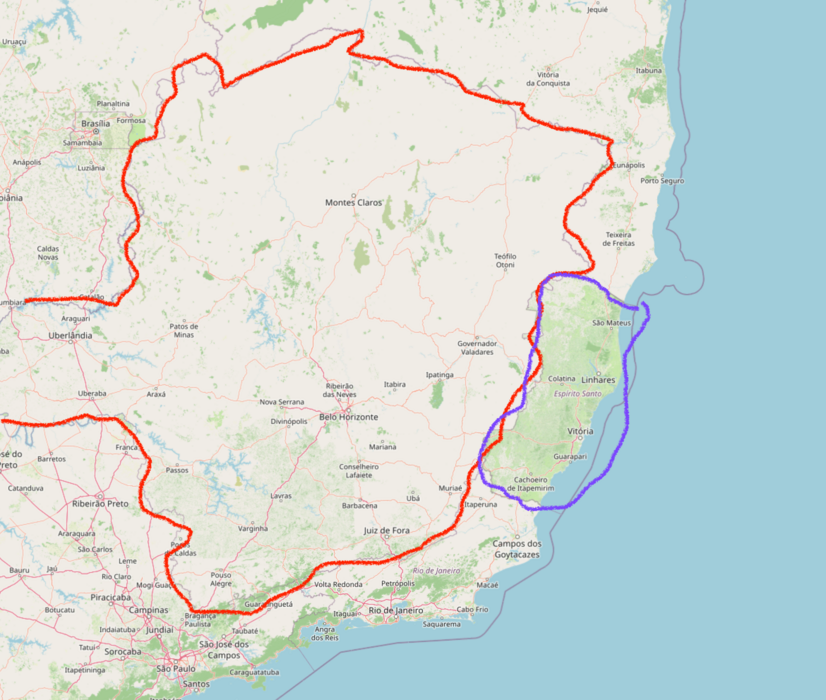
My hope again is that if I can get better data in Espírito Santo then I can find enough points that are similar to Minas Gerais to help in the embedding space.
It's also worth noting that this problem isn't unique to us: Lumbierres et al is similarly going to be impacted by this issue. However, as ever in this domain something is better than nothing, and understanding the limitations is just as important as the artifact itself.
Misc
I had intermittent power outage on Friday which took me off main duties, so I finally migrated my other website over to my newer EIO/Htmlit based stack that powers this one. Whilst I quite liked the Dream framework that powered the old one, it did seem to hang once a week and need restarting, whereas the new one based on EIO has been solid.
The migration did make me realise just how much div spam there are in my pages in a vague attempt to make them reactive (both to screen size and content). It's quite horrible under the hood. I do kinda wish I could just go back to doing explicit pixel coordinate layouts: perhaps I just put all the content in hidden divs and manually lay them out in javascript based on the current viewing area... thankfully I dislike web development enough that I'll leave that yak unshaven :)
This week
- More data gap plugging
- More habitat map experiments
- I need to send some data to people, which is still an annoying process for things I can't publish for everyone
- Open Source Hardware Camp 2026