Weeknotes: OggCamp 2026
Apr 27, 2026
This weekend was OggCamp 2026, a community run conference on open source, open data, and open culture. I always find OggCamp a bit hard to define, as it covers a mix of very techy talks (talks on new languages, devops tools, etc.), has a strong societal impact focus (the UK's Open Rights Group are there every year), and increasingly welcoming to where technology intersects with art and design. Add to that there's usually a mix of both hardware, and software - it can feel a bit broad and vague in abstract, but when you're there it seems to work well thanks to the guidance of the organisers who curate the main track (there are two unconference tracks too).
This year I unfortunately missed the first day, as Saturday was also Wirral Makefest where I had a stand explaining how guitars are built, and thus I have some catching up to do, but what I did see on the Sunday I enjoyed a lot, and is summarised below.
Talks I saw
As mentioned, I unfortunately missed the Saturday, but I saw a good range of talks on the Sunday.
First up was Bonnie Mehring from the Free Software Foundation Europe, who talked about their efforts to engage young people in the issues around technology ownership, rights, and repairability. She talked about the community efforts that gave sprung up around the Ada & Zangemann book they publish (which I really do need to get a hold of), including people turning it into a board game, and the Youth Hacking 4 Freedom program that works to get teenagers building open source tools for themselves. Normally the framing for organisations such as the FSFE, ORG, and EFF are focussed on the pushback with large tech organisations, so it was nice to learn something of this engagement with younger people who increasingly will have not seen the old free and open Internet that I had the luxury of experiencing growing up.
Next I enjoyed Chris Ellis talk about his continued work building LED badges. Whilst it talked a little about the hardware (enough to explain the pain points addressed in his new work), the main focus was on how he's managed to move his programming environment for the badges to be completely web based. The badges can have up to 60 LEDs on them, and to program in visual effects Chris made his own little virtual machine for executing patterns to help keep the code size down and ease programming. At first me made a little web based simulator to help develop the visual effects, showing you how the code would run on the badge, but with clever trickery and web-serial he's managed to actually make that the programming environment for the real badges. A great example of how OggCamp brings together the very nerdy and the visual arts nicely.
After attending the hallway-track for a bit, and getting my conference t-shirt, I then listened to Ian Forrester and Sam Margerison talk about how we might manage our digital legacy after we die. In addition to just being a thought provoking piece, there was some technical bits about the differences between a will and a statement of wishes that I'd never thought to consider: for example, once you die your will becomes part of the public record, so it's probably a bad idea to put account passwords in there. Apparently people do, and there's people who will search such public records to abuse such information. In general though they covered the pain of trying to do anything with current services to ensure appropriate transition happens with a person's digital estate after death, despite the fact there is ever increasing financial and emotional value in what is held there. Given most companies don't think about usage of their product beyond the next funding round or sales quarter, this isn't surprising, but is clearly a problem for society. Sam and Ian have been exploring ways to express some end of life wishes around your online data, which clearly is in a very early stage, but it is good that we have people thinking about this.
On a slightly lighter note, next up I saw Tom Chiverton talk about the struggles of owning your own music collection these days and presenting O!MPD, which is a home music server that will stream music to various output devices and has a simple reactive web interface that works from desktop and mobile. As someone who periodically struggles with the same question (as in I struggle to get a working setup, and get frustrated, then about a year or so later repeats the process), I was pleased to learn about another tool in this field I wasn't aware of. Between the self hosting efforts of my group colleagues, and other fediverse friends - both of whom are using Navidrome, which I've also yet to try - I feel perhaps it's time to try again at getting off the convenience of streaming even for music I already own.
The penultimate talk I saw was by John McAleely on his Yarg language - which is an attempt to make a microcontroller-first language that has the convenience of tools like micro-Python but first class support for things like interrupt handling and direct mapping of memory registers to global variables without messing around with pointers. Interestingly he tackled having a REPL environment on the microcontroller to make it easier for people to do early exploratory programming on dev boards, which isn't something I've seen prioritised before, and makes a lot of sense if you think about the success of micro-Python in the hobby domain. Unfortunately given the talk slot size, he didn't get time to dive into details, but it was enough to make me curious to learn more about it!
Finally, I went to one of the unconference sessions ran by Jim [insert second name here, I'm very sorry Jim, I forgot 🤦] on OpenSCAD and Build123d - two different programmatic ways at defining 3D geometries for CAD purposes. I've tried OpenSCAD before and bounced off it, but it was interesting to listen to Jim talk about, as it made is slightly more obvious that whilst there are limitations in what OpenSCAD can do that make it suboptimal for say guitar design, I think at least some of the problems I have with it stem from my approach and trying to force it to reproduce my workflow in Fusion 360.
Build123d was an entirely new tool to me. Unlike OpenSCAD, which has a declarative custom language for expressing designs (an approach I am a big fan on), Build123d is (as I understand it) basically a set of Python libraries that allow you to build your design up in Python. In addition to a different approach, it does seem to have a few of the CAD niceties that OpenSCAD lacks, like the ability to do simple fillets and chamfers. Indeed, Jim said that despite it not being as mature as OpenSCAD he'd pretty much switched over after being a long time OpenSCAD user.
Two things that came from the discussion with the audience was that a lot of people are using OpenSCAD unstable builds, so I should perhaps give that a go as I think I just used the stable version, and that there's apparently a lot of libraries for OpenSCAD for common forms, which I never looked into.
My own talk
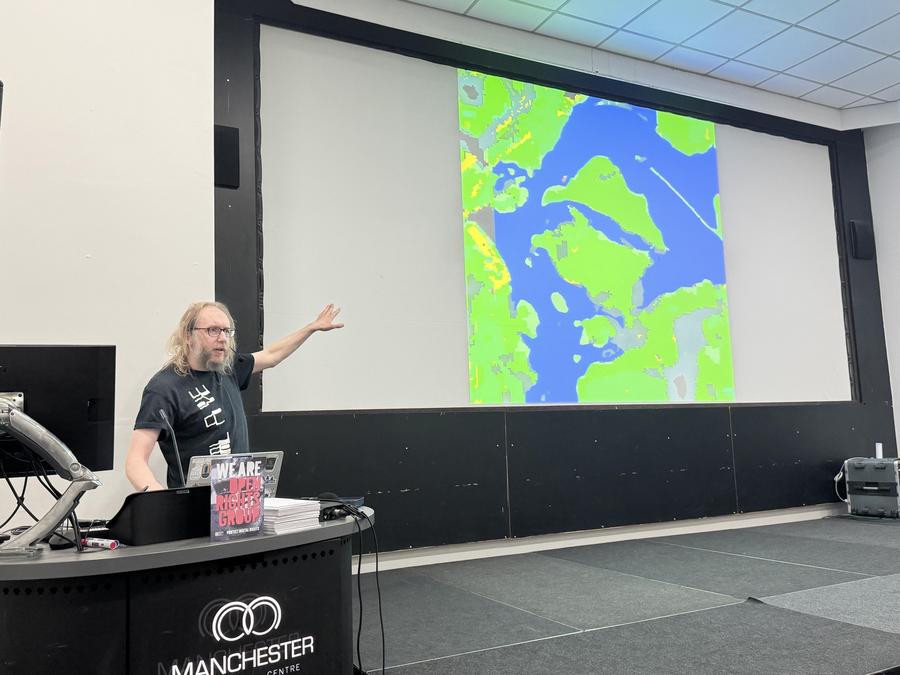
At the previous OggCamp I gave a talk about how open source software underpins a lot of the climate research that I see happening at the Cambridge Conservation Initiative, and it was a semi-serious look at where the tooling helps, and where it hinders, ecologists who are busy trying to save the planet. This year, I decided to a slightly more light hearted talk, and instead used the example of my Minecraft map of Kullberg in Sweden to show people how they might dip their toe into playing around with all the open data there is out there about the world we live in:
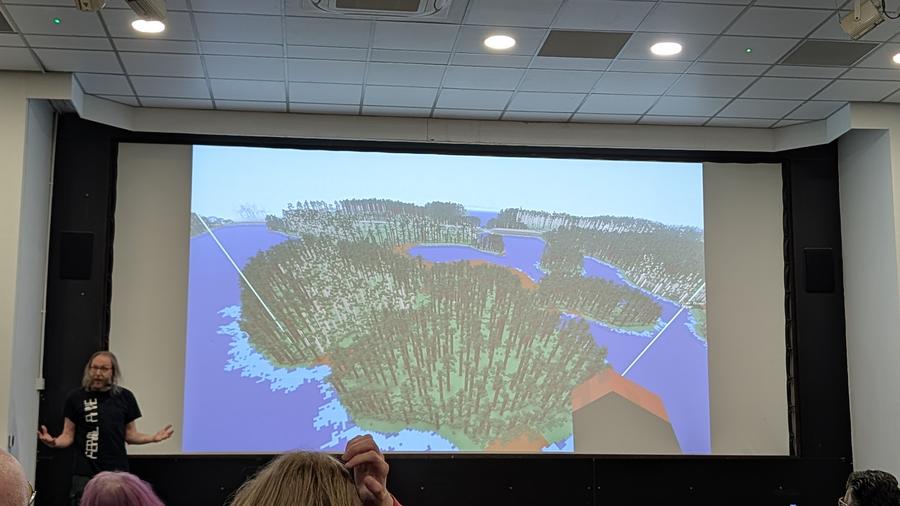
If that sounds like your kind of thing you can watch the talk here:
Thanks to Andy Piper and Margaret Low for the photos!
Talks I want to catch up on
I definitely want to watch Margaret Low's talk on algorithmic art using CNC embroidery machines - Margaret gave an excellent introduction to Turtlestitch last year, and the examples of art she had on display in the OggCamp chill seating area were really good, and reminded me of some of the fun I had using Claudius to take part in Genuary. The embroidery art examples she had on display were super-interesting, not just visually, but you also get a sense of texture from them, which made me wonder if that could be used as another data-realisation avenue for say partially sighted people.
Everyone seemed to have a good thing to say about the Infrastucture as Code talk - as someone slightly allergic to devops, this wasn't on my radar, but given the rave reviews, I think I'll need to get over my biases here and give this a gander.
Wrapping up
Even though that is a list of talks filtered through my own personal preferences, hopefully it explains the wonderful breadth of topics OggCamp covers, which is why I enjoy going so much. I missed half the conference, yet still left having learned a bunch of things and with some new ideas to follow up.
A big thank you to all the OggCamp crew who made it happen and ensured it all ran smoothly and interestingly!